
The number
Four out of five searches on our Christian business directory come back empty, and after eleven weeks of data the reason turned out to be geography rather than the missing trades we expected.
The raw count: between June 12 and August 27, 2026, people typed 276 searches into ChristianBizFinder, and 219 of them returned nothing at all.
That is an uncomfortable number to publish about your own product. We are publishing it because the shape of those empty searches turned out to be more useful than the count, and because the useful part is not what we expected to find.
What we expected to find
We assumed the gaps would be about trades. A directory this young has obvious holes, so we expected the data to say something like: get more plumbers, get more heating and air companies, get more counselors. Recruit those categories and the empty searches go away.
That is not what the data says. Sorted by category, the empty searches are thin and scattered. The largest single category across eleven weeks was roofing, at 14 searches. Plumbing was 8. More than half of the empty searches, 119 of 219, did not name a category our parser could identify at all.
What the data actually says
People were not searching for a category. They were searching for a place.
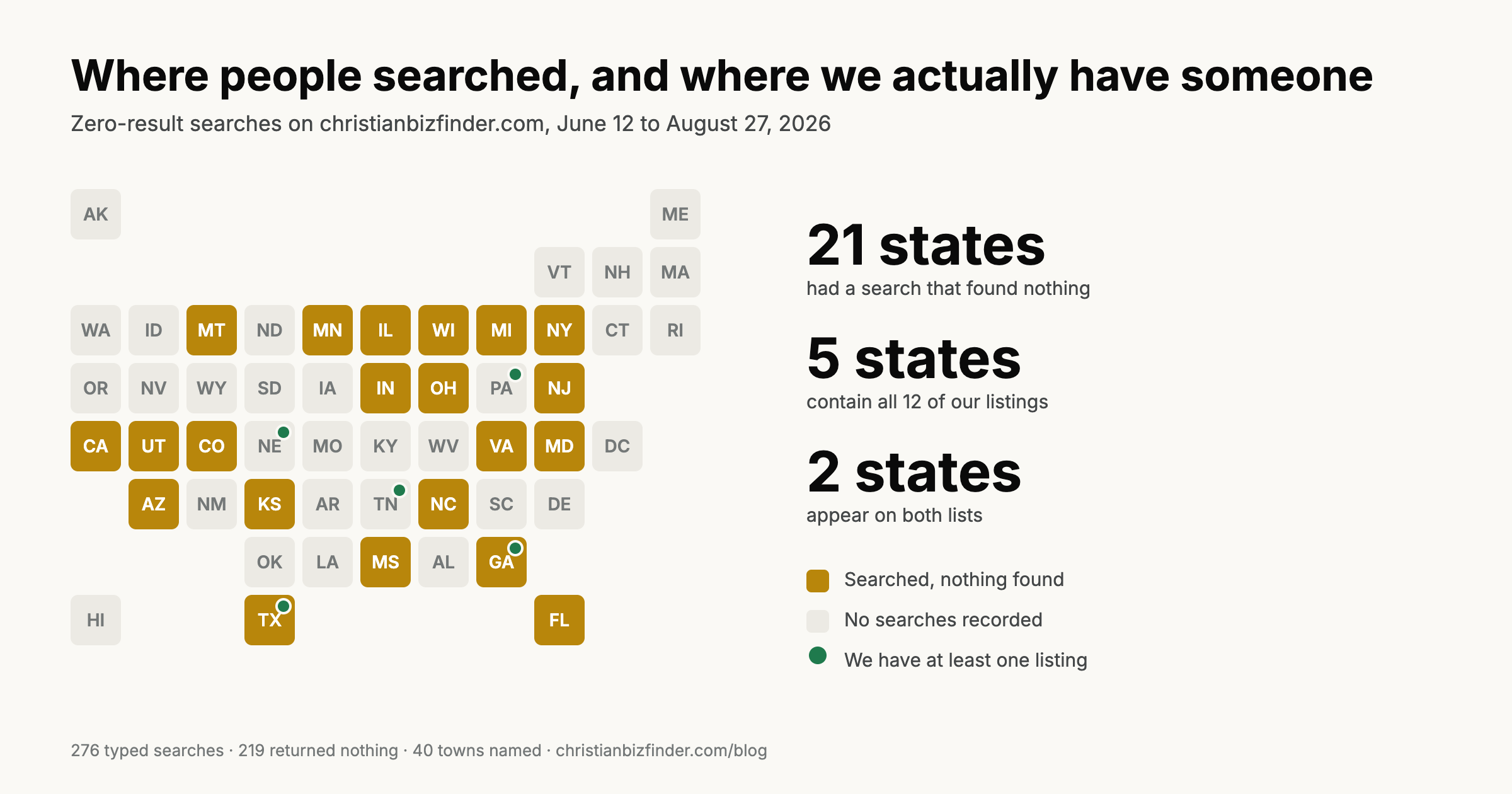
Of the 219 empty searches, 111 named a specific town, city, or ZIP code. Those 111 searches named 40 different places across 21 states. Lindale and Longview in Texas. Missoula, Montana. Battle Creek, Michigan. Lafayette, Indiana. Queen Creek, Arizona. Palmetto and Carrollton, Georgia. Eau Claire, Wisconsin. Meridian, Mississippi. Sherrills Ford, North Carolina.
85% of the place-naming searches pointed somewhere outside Texas.
Here is the part that explains the 79%. We currently have 12 live listings, spread across 10 towns in 5 states. Of the 21 states people searched in, exactly two have a single listing in them. The map of who is looking and the map of who is listed barely touch.
One visitor in Lindale, Texas searched 15 times in a single day and left with nothing. We want to be precise about that: it is one person having a frustrating afternoon, not 15 separate people. But it is a person who wanted very badly to find someone local and could not.
What we got wrong the first time
An earlier internal version of this analysis said something much more dramatic. It reported 91 empty searches for plumbing, 83 for heating and air, and 71 for counseling, each spread across more than 40 separate days. Sustained demand, in other words, and a clean recruiting list.
Re-checking it before publishing, those numbers did not hold up.
Most of those rows were not people typing searches. They were hits on the category tiles on our homepage, and a large share of those came from web crawlers walking every tile link in sequence. We found 19 clusters where five or more different categories were requested within five seconds of each other. No human browses that way.
Worse, we had built a guard against exactly this mistake and it failed. The guard was to count how many separate days a pattern appeared on, on the theory that a single burst of fake traffic would land on one day and real demand would spread out. But a crawler comes back day after day. Spreading across 40 days is precisely what automated traffic looks like.
After removing tile clicks, crawler bursts, and queries hard-coded in our own test scripts, plumbing went from 91 to 8, heating and air from 83 to 2, and counseling from 71 to 1. The category story we thought we had was mostly our own infrastructure talking to itself.
The geographic finding is what survived the cleaning, which is part of why we trust it.
What we changed
We now tag crawler traffic at the moment a search is written, rather than trying to guess months later. We also record whether a search was typed by a person or was a click on a category tile, because pooling those two was the root of the error.
The cleaning steps now live in a script in the repository instead of in someone's ad-hoc query, so these numbers can be re-run and checked rather than taken on faith.
How to check our work
Every number above comes from our own search logs, cleaned in this order: remove our own verification traffic, remove anything tagged as a crawler, remove clusters of five or more requests within five seconds, remove queries hard-coded in our test suites, then report typed searches separately from category-tile clicks.
Things worth holding against these numbers:
- 276 searches is a small sample. This is a young directory, and nothing here should be read as a claim about Christian-owned business nationally.
- Most towns were named on a single day, so a count of searches is not a count of people. Where we say 15 searches, we mean 15 searches.
- We excluded category-tile clicks entirely. Some of those were real people, and dropping them makes our numbers conservative rather than neutral. Before late August 2026 we had no reliable way to tell a person clicking a tile from a crawler following a link.
- 119 of the 219 empty searches had no category our parser could identify, so the category counts are a floor, not a total.
If you own a business
The honest read on all of this is that demand for what we are building is real and it is scattered, and that a directory grown by referral fills in unevenly. Someone in Missoula went looking for a business owner who shares their faith and found an empty page. That is not a marketing problem. It is just a gap, and gaps get closed one owner at a time.
There are two doors from here, and both of them are free.
List your business if you own one. Send us one if you know one worth listing. The second one matters more than it sounds. Nearly every listing here arrived because somebody vouched for somebody else.